John G. Thompson, Eugene S. Libby, Edwin P. Ruggles, William R. Chase, T. Duncan Patton, Frank The history of basketball began with its invention in 1891 in Springfield, Massachusetts by Canadian physical education instructor James Naismith as a less injury-prone sport than football. Naismith was a 31-year old graduate student when he created the indoor sport to keep athletes indoors during the winters.[1] The game became established fairly quickly and grew very popular as the 20th century progressed, first in America and then in other parts of the world. After basketball became established in American colleges, the professional game followed. The American National Basketball Association (NBA), established in 1946, grew to a multibillion-dollar enterprise by the end of the century, and basketball became an integral part of American culture.
Invention of the game
The game of basketball as it is known today was created by Dr. James Naismith in December 1891 in Springfield, Massachusetts, to condition young athletes during cold months. Naismith was a physical education instructor at YMCA International Training School (now known as Springfield College) in Springfield, Massachusetts. Upon the request of his boss, Naismith was tasked to create an indoor sports game to help athletes keep in shape in cold weather.[2] It consisted of peach baskets and a soccer style ball. He published 13 rules for the new game. He divided his class of eighteen into two teams of nine players each and set about to teach them the basics of his new game. The objective of the game was to throw the basketball into the fruit baskets nailed to the lower railing of the gym balcony. Every time a point was scored, the game was halted so the janitor could bring out a ladder and retrieve the ball. After a while, the bottoms of the fruit baskets were removed. The first public basketball game was played in Springfield, Massachusetts, on March 11, 1892.[3]
Naismith’s original rules
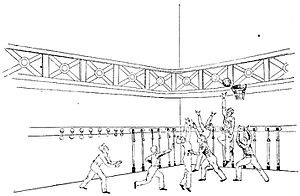
An illustration of a basketball game that accompanied Nasmith’s article from The Triangle in 1892 listing his 13 rules.
There were only thirteen rules of “basket ball”:
- The ball may be thrown in any direction with one or both hands.
- The ball may be batted in any direction with one or both hands.
- A player cannot run with the ball, the player must throw it from the spot on which he catches it, allowance to be made for a man who catches the ball when running at good speed.
- The ball must be held in or between the hands, the arms or body must not be used for holding it.
- No shouldering, holding, pushing, tripping or striking in any way the person of an opponent shall be allowed. The first infringement of this rule by any person shall count as a foul, the second shall disqualify him until the next goal is made, or if there was evident intent to injure the person, for the whole of the game, no substitute.
- A foul is striking the ball with the fist, violation of rules 3 and 4, and such as described in rule 5.
- If either side makes three consecutive fouls it shall count a goal for opponents.
- A goal shall be made when the ball is thrown or batted from grounds into the basket and stays there. If the ball rests on the edge and the opponent moves the basket it shall count as a goal.
- When the ball goes out of bounds it shall be thrown into the field and played by the person first touching it. In case of a dispute, the umpire shall throw it straight into the field. The “thrower-in” is allowed five seconds. If he holds it longer it shall go to the opponent. If any side persists in delaying the game, the umpire shall call a foul on them.
- The umpire shall be the judge of the men and shall note the fouls, and notify the referee when three consecutive fouls have been made.
- The referee shall be the judge of the ball and shall decide when the ball is in play, in-bounds, and to which side it belongs, and shall keep the time. He shall decide when a goal has been made and keep account of the goals with any other duties that are usually performed by a referee.
- The time shall be fifteen-minute halves, with five-minute rests between.
- The side making the most goals in that time shall be declared the winner. In the case of a draw, the game may, by agreement of the captains, be continued until another goal is made.[4]
The first basketball game
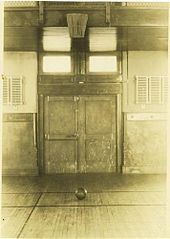
The first basketball court: Springfield College
On December 21, 1891, Naismith published rules for a new game using five basic ideas and thirteen rules.[5] That day, he asked his class to play a match in the Armory Street court: 9 versus 9, using a soccer ball and two peach baskets. Frank Mahan, one of his students, wasn’t so happy. He just said: “Harrumph. Another new game”.[6] However, Naismith was the inventor of the new game. Someone proposed to call it “Naismith Game”, but he suggested “We have a ball and a basket: why don’t we call it basketball?”[7] The eighteen players wereMahan, Finlay G. MacDonald, William H. Davis and Lyman Archibald, who defeated George Weller, Wilbert Carey, Ernest Hildner, Raymond Kaighn, Genzabaro Ishikawa, Benjamin S. French, Franklin Barnes, George Day and Henry Gelan 1–0.[8] The goal was scored by Chase.[9] There were other differences between Naismith’s first idea and the game played today. The peach baskets were closed, and balls had to be retrieved manually, until a small hole was put in the bottom of the peach basket to poke the ball out using a stick. Only in 1906 were metal hoops, nets and backboards introduced. Moreover, earlier the soccer ball was replaced by a Spalding ball, similar to the one used today.[10][11]
 ALL ABOUT BASKETBALL

